Introduction to Computational Fluid Dynamics (CFD)
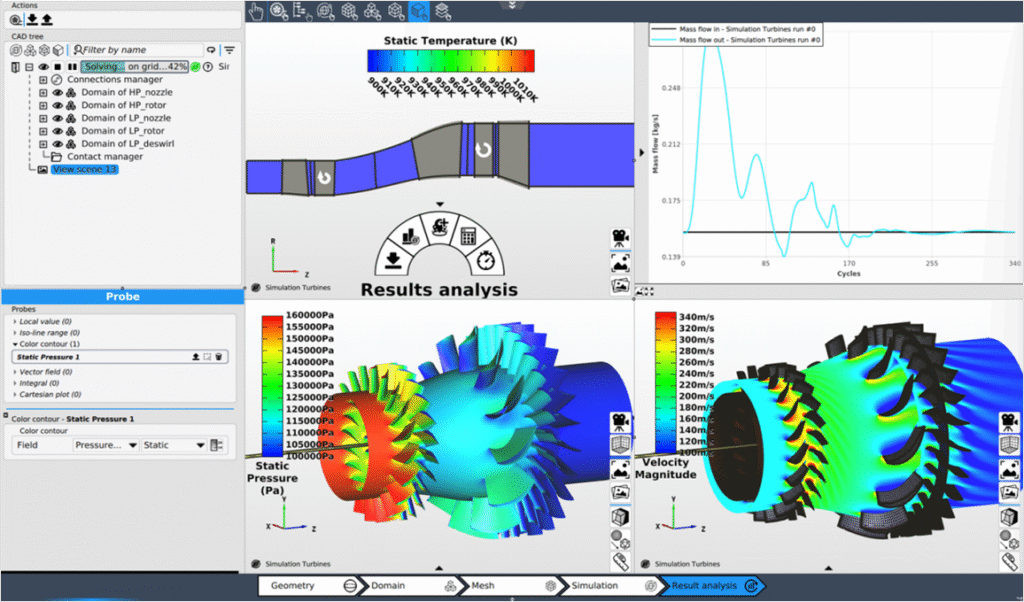
Computational Fluid Dynamics (CFD) is a branch of fluid mechanics that uses numerical analysis and algorithms to solve and analyze problems involving fluid flows. CFD simulations are widely used in various industries, including automotive, aerospace, HVAC, energy, and environmental engineering. By solving the Navier-Stokes equations through numerical methods, CFD helps engineers optimize designs, predict performance, and reduce costly physical testing.
Advanced CFD software packages allow for high-fidelity numerical simulation of both steady-state and transient phenomena, making CFD a cornerstone of modern engineering design and flow modeling.
Flow Analysis with CFD: An Overview
CFD begins with defining the physical domain and generating a computational mesh. The software then simulates fluid behavior by solving mathematical models such as the Navier-Stokes equations. Laminar flow and turbulent flow behaviors are handled through turbulence models such as k-ε and LES, depending on the application.
Engineers analyze pressure drops, velocity fields, and flow separation, using the insights to make design decisions. CFD also enables what-if scenarios, where design alternatives are tested virtually to optimize performance.
External Flow Analysis: Aerodynamics for Buildings and Vehicles
External flow analysis is crucial for applications like building façade load calculations and vehicle aerodynamic performance. CFD simulates wind pressure on tall structures, helping architects and engineers ensure safety and compliance with building codes.
In the automotive industry, CFD helps minimize car drag coefficients and improve fuel efficiency. Compared to expensive wind tunnel tests, CFD external simulations offer faster and cost-effective insights into vehicle design and structural aerodynamics.
Internal Flow Analysis in Mechanical Systems
CFD is extensively used in internal flow analysis, especially in components like pipelines, nozzles, and ducts. One application is in turbo machinery, where flow behavior inside casings and blades determines efficiency. Engineers use CFD to optimize blade angles, reduce flow separation, and increase performance.
In HVAC systems, internal flow simulations help visualize air distribution within enclosed spaces, ensuring uniform heating, cooling, and ventilation.
Turbo Machines: Fans, Pumps, and Wind Turbines
CFD plays a central role in impeller design and performance prediction of turbo machines. For example, in pump design, engineers simulate flow inside the volute to ensure the desired pressure head and minimize losses.
In wind turbines, CFD helps optimize blade shape and angle of attack, improving overall energy capture. Rotating machinery simulations provide detailed insights into turbulent zones, cavitation risk, and mechanical efficiency.
HVAC and Thermal Comfort with CFD
In building design, maintaining thermal comfort is key. CFD simulates airflow and temperature distribution within indoor spaces, optimizing the placement of vents and diffusers. In Tractor Cabin HVAC Analysis, CFD helped compare air distribution during summer and winter, enabling improvements in passenger comfort.
CFD also allows the study of contaminant spread within indoor environments, a critical factor in healthcare facility ventilation systems.
Heat Transfer Calculations Using CFD
CFD enables the simulation of conduction, convection, and radiation in complex geometries. Heat exchangers, cooling fins, and electronic components are analyzed using CFD to manage thermal loads.
Thermal resistance and heat flux can be visualized, allowing design optimizations that ensure durability and efficiency. CFD-based heat transfer modeling reduces the need for costly thermal prototypes.
Combustion and Environmental Impact Simulations
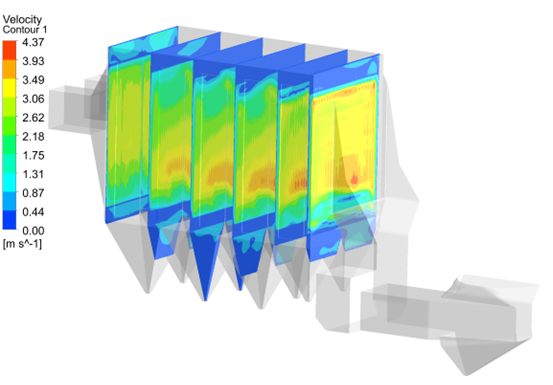
CFD is an essential tool in modeling combustion processes within engines, furnaces, and chimneys. It helps evaluate emission levels, smoke dispersion, and pollutant concentration in real-world environments.
In power plants like Yatağan Thermal Power Plant, CFD has been used to simulate ESP (Electrostatic Precipitator) performance, optimize flow, and reduce emissions. This supports environmental compliance and energy efficiency.
Case Studies: Real-World CFD Applications
▸ Tractor Cabin HVAC Analysis
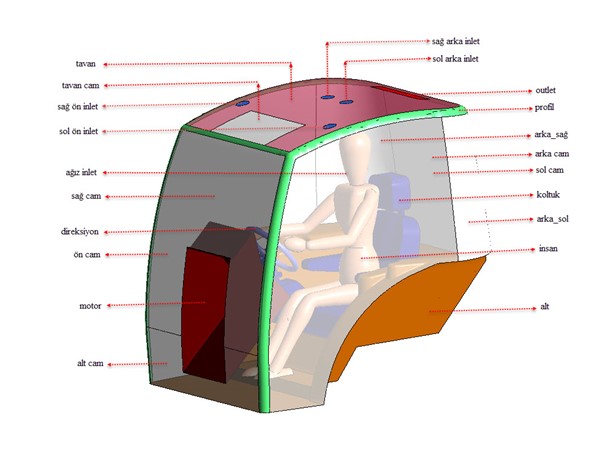
By blowing air with various characteristics and measuring temperature distribution, CFD helped compare actual performance with simulation results under both summer and winter conditions.
▸ Yatağan Thermal Power Plant Gas Channel Flow Optimization
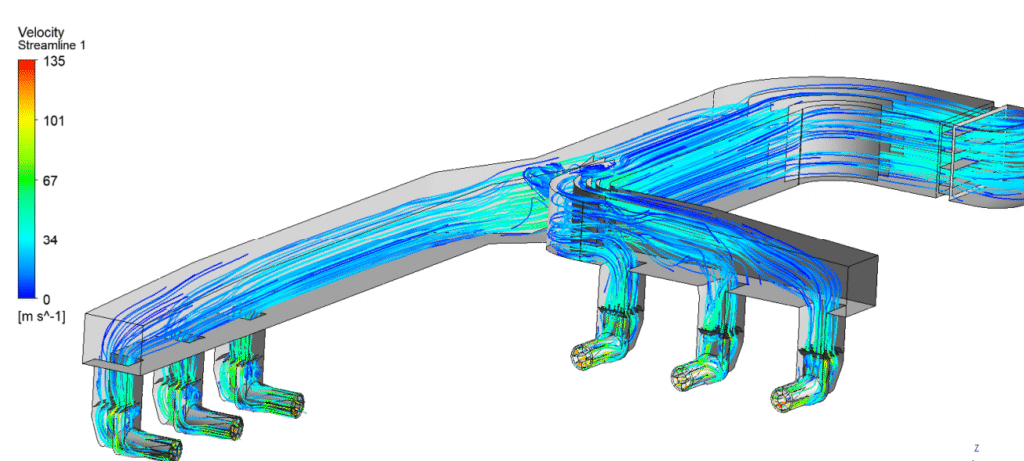
CFD analysis was conducted to enhance gas flow through complex ductwork, optimizing velocity profiles and reducing pressure losses.
▸ Pump Impeller Design
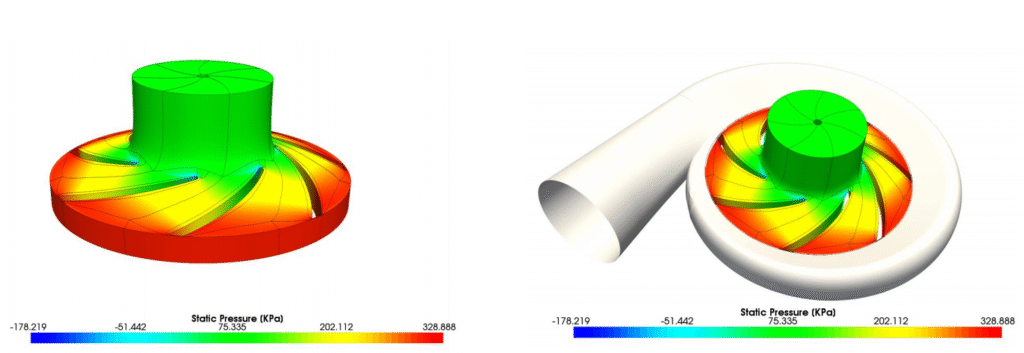
A pump impeller was designed using CFD to meet specific pressure head requirements, optimizing for a constant volute volume and diameter, improving energy efficiency and reducing wear.
Future of Computational Fluid Dynamics in Engineering
The future of CFD is being shaped by AI, cloud computing, and digital twins. Machine learning algorithms are accelerating mesh generation and simulation convergence. Cloud-based CFD platforms are reducing hardware dependency and improving collaboration across global teams.
Digital twin technology, where CFD simulations are paired with real-time data from sensors, allows for predictive maintenance and smart decision-making, opening new avenues for CFD across industries.
FAQ SECTION
1. What is Computational Fluid Dynamics used for?
Computational Fluid Dynamics is used to simulate and analyze fluid flows in various applications such as HVAC systems, aerodynamic design, heat transfer, and combustion.
2. How accurate is Computational Fluid Dynamics?
CFD is highly accurate when proper boundary conditions, mesh quality, and solver settings are used. It provides reliable insights comparable to experimental results.
3. Where is Computational Fluid Dynamics applied?
CFD is applied in industries like aerospace, automotive, energy, architecture, and environmental engineering to improve performance and reduce development time.
4. What software is used for Computational Fluid Dynamics?
Popular CFD software includes ANSYS Fluent, OpenFOAM, COMSOL Multiphysics, and STAR-CCM+.
5. Can Computational Fluid Dynamics predict pollution spread?
Yes, CFD is widely used to model smoke distribution, pollutant concentration, and environmental impacts of emissions.